
.png)


Hilltop Homestead: The Farmhouse That Became a Barn

A Building That Refused to Disappear

Most historic farmhouses follow one of two paths. They are either preserved as homes or abandoned as agriculture evolves around them. Hilltop Homestead followed neither.
Perched on elevated ground in the Scottish Borders, the original farmhouse at Hilltop Homestead remains exactly where it has stood for more than two centuries. The family homes have moved. The farm has expanded. Agricultural practices have changed. Yet the original structure remains, not as a relic of the past, but as a building that adapted to the needs of every generation that followed.
Known by Three Forks® as Hilltop Homestead, this remarkable structure tells a story of evolution rather than replacement. Built as a residence in the late eighteenth century and later transformed into a working agricultural building, it preserves both phases of its history within the same walls.
It is not simply a farmhouse.
It is the original heart of the farm itself.
Project Specifications
Project Name: Hilltop Homestead
Location: Scottish Borders, Scotland
Estimated Construction Date: Late 1700s
Historical Significance: Original farmhouse later converted into a working agricultural barn
Primary Materials Available:
23 Scots Pine truss assemblies
11 primary cross beams averaging 16 feet in length
Original structural members from the residential phase
Historic agricultural conversion framing
Early nineteenth-century hardware and lock mechanisms
The Original Center of Farm Life

Long before modern farmhouses were built across the road, this structure served as the primary residence of Hilltop Homestead. Its elevated position was intentional. From its hilltop location, the occupants could oversee the surrounding fields, livestock, and daily operations. Visibility, drainage, and proximity to the land were priorities in an era when farming and family life were inseparable.
The building reflected the practical realities of eighteenth-century rural Scotland.
Thick masonry walls provided protection from the elements. Small openings offered light while conserving heat. Living quarters and agricultural responsibilities existed side by side.
This was not a grand country house. It was a working farmhouse built for people whose lives were defined by the land around them.
A New Purpose for an Old Structure
As agriculture expanded throughout the nineteenth century, farms across the Scottish Borders faced changing demands. Buildings that once served one purpose often needed to serve another. At Hilltop Homestead, the decision was not to demolish the original farmhouse.
Instead, it was transformed.
The second-floor system was removed, opening the interior vertically and creating the larger volume needed for agricultural use. Large two-story doors were installed to accommodate equipment, livestock, and farm operations. The structure that had once sheltered a family became a central part of the working farm.
Yet remarkably, the transition never erased its origins. The building continued to carry evidence of both identities at the same time. That duality is what makes Hilltop Homestead so distinctive.
The Details That Remain

Historic buildings often reveal their stories through the smallest surviving details. At Hilltop Homestead, one of the most remarkable examples is found in a side entrance that still retains its original round lock mechanism from the early nineteenth century. The hardware survived the conversion.
It survived changing ownership generations. It survived the transformation from residence to agricultural structure. Today, it remains in place as a quiet reminder of the building's first life.
Moments like this provide a rare opportunity to see history layered rather than replaced.
The house became a barn, but traces of the house never disappeared.
Architecture Shaped by Adaptation
Unlike purpose-built agricultural structures designed around a single system, Hilltop Homestead reflects multiple phases of construction and use. The original residential layout established the building's proportions and structural spacing. Later modifications introduced agricultural framing systems and vertical interior volumes more suitable for farm operations.
As a result, the building possesses a character unlike the larger estate barns found elsewhere in the Borders.
It is not defined by uniformity. It is defined by adaptation. Every beam and truss reflects a decision made by a previous generation seeking to preserve the usefulness of the structure while responding to changing needs. The building evolved because it was valued. That story remains visible today.
Scots Pine with a Story
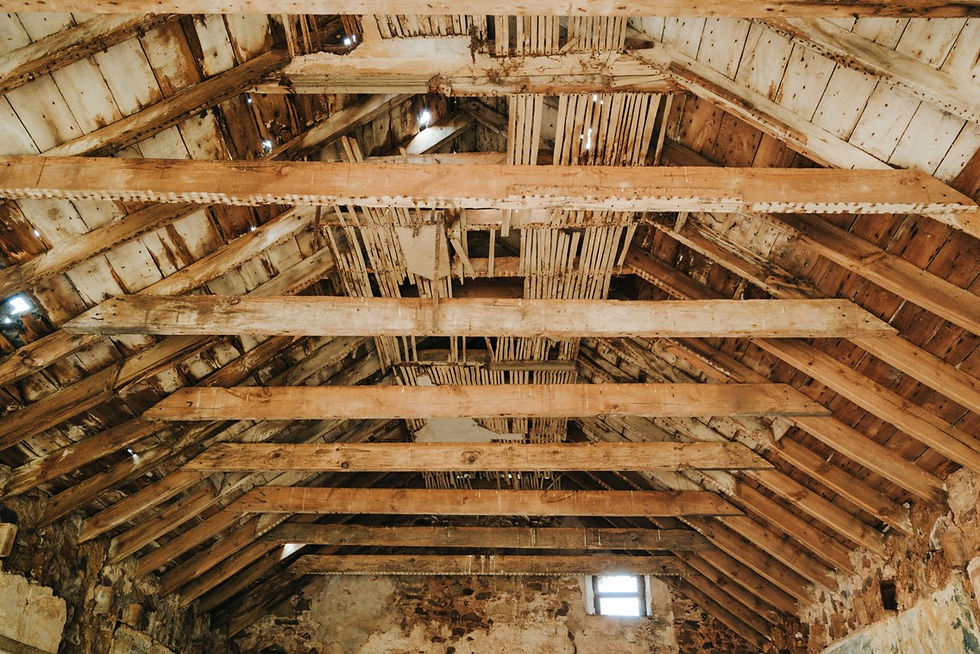
The reclaimed material available from Hilltop Homestead reflects both its residential and agricultural histories. The primary Scots Pine framing system includes twenty-three truss assemblies and eleven substantial cross beams, along with additional structural members tied to earlier phases of the building. Unlike highly repetitive agricultural framing systems, the material here reflects the complexities of conversion.
Some members originated within the farmhouse itself. Others were added during the transition to agricultural use. Together, they create a collection of reclaimed timber that carries the marks of multiple generations and multiple purposes. Every piece tells part of the story.
Preserving the Original Homestead
What makes Hilltop Homestead especially significant is that it remains connected to its origins.
The original farmhouse still overlooks the same land it was built to serve. The farm continues to operate. The property remains under continuous family ownership. The story has never been interrupted.
This continuity gives meaning to every surviving beam, every truss, and every piece of hardware. They are not isolated artifacts. They are components of a living agricultural history.
The Legacy of Hilltop Homestead

Hilltop Homestead represents a rare form of preservation. Not preservation through restoration. Not preservation through inactivity. But preservation through adaptation.
For more than two centuries, the building has remained useful because each generation found a new purpose for it while respecting what came before. The result is a structure that embodies both change and continuity.
A farmhouse that became a barn. A home that became part of a working agricultural system.
A building that never stopped serving the land around it. Through thoughtful reclamation and preservation, that story will continue long after the final chapter of its working life has been written because some structures survive by standing still. Hilltop Homestead survived by evolving.


Comments