
.png)


A Quiet Legacy in the Yarrow Valley

Where the Landscape Still Leads the Story

Not every historic structure was built to dominate the landscape. Some were built to belong to it. High above the working farmyard at Shepherds’ Draw, a small detached building rests on elevated ground overlooking the Yarrow Valley. Modest in scale and simple in design, it lacks the imposing presence of a great barn or estate steading. Yet what it possesses is something increasingly rare—a direct and uninterrupted relationship to the land it was built to serve.
Known by Three Forks® as Shepherds’ Draw, this structure represents a quieter side of Scottish agricultural history. It tells the story of grazing land, seasonal movement, family stewardship, and a farming tradition that has endured in the Borders for generations. Its value is not measured by size. It is measured by authenticity.
Project Specifications
Project Name: Shepherds’ Draw
Location: Yarrow Valley, Selkirk, Scottish Borders, Scotland
Historic Context: Estate-era tenant farm with documented agricultural history dating to the late 18th century
Primary Materials Available:
Scots Pine truss crossbeams
Original roof framing members
Historic threshold timbers
Structural Scots Pine components from a complete detached building
Preserved agricultural framing system
Historical Significance: Detached agricultural structure connected to centuries of pastoral farming and generational stewardship in the Yarrow Valley
A Landscape Defined by Grazing and Stewardship

The Yarrow Valley has long been shaped by agriculture. For centuries, its rolling hills, open grazing grounds, and scattered farmsteads supported a way of life built around livestock, seasonal rhythms, and careful stewardship of the land. Shepherds’ Draw formed part of that landscape long before modern farming practices emerged.
Historical records show that by the late eighteenth century the area was already undergoing organized agricultural improvement. Farms were divided, reorganized, and integrated into broader estate systems designed to improve productivity while supporting the families and tradespeople who lived and worked there. Shepherds’ Draw became part of that story.
Over time, neighboring holdings were absorbed into the surrounding landscape, creating a larger and more connected agricultural system while maintaining the pastoral character that continues to define the valley today.
A Place with Deeper Roots
The history of Shepherds’ Draw extends beyond farming alone. Above the farm once stood the old Tower of Catslack, a structure now lost to time but preserved in local memory and historical accounts. Stories associated with the tower connect the site to the turbulent history of the Scottish Borders, where family allegiances, territorial disputes, and shifting loyalties shaped life for centuries.
Accounts suggest that a member of the Buccleuch lineage died there, embedding the location within the broader narrative of Borders history. Whether viewed as documented history or enduring local tradition, the story reinforces an important truth. This land has witnessed generations of human activity long before the structures standing today were built. The farm exists within a much larger historical landscape.
Building a Life in the Valley
By the mid-nineteenth century, Shepherds’ Draw had become a substantial agricultural operation. Census records from 1861 describe a farm of approximately seven hundred acres employing multiple workers and supporting significant agricultural production. The property operated within the larger Buccleuch estate system, where tenant farming relationships often extended across generations.
For many families, stewardship became a lifelong commitment. At Shepherds’ Draw, that tradition continued for three generations. Then, in 2016, something extraordinary happened. The current owner was given the opportunity to purchase the property outright from the Duke of Buccleuch. He later described it as a "once in three generations opportunity."
The moment represented far more than a real estate transaction. It marked the transition from tenancy to ownership. Responsibility became legacy. Stewardship became permanence.
The Building Above the Farm
The structure that inspired the name Shepherds’ Draw stands apart from the primary working farm. Positioned on higher ground north of the farmhouse, it occupies a location that feels intentionally connected to the surrounding landscape. It overlooks grazing areas below while remaining visually tied to the valley beyond.
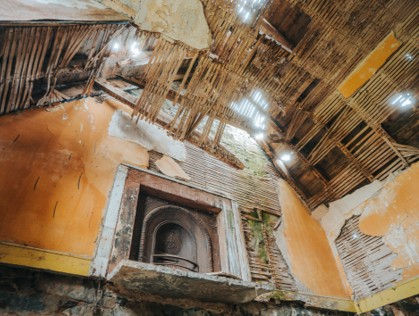
Unlike heavily modified agricultural buildings, this structure has retained much of its original character. Its proportions remain intact. Its roof system remains legible. Its relationship to the land remains unchanged. The building does not feel separated from its environment. It feels rooted within it. That distinction gives the structure much of its power.
Preserving a Complete Structural Story

The Scots Pine framing system within Shepherds’ Draw remains remarkably understandable. The roof structure survives as a coherent whole rather than a collection of isolated pieces. Truss crossbeams, roof framing members, and threshold elements continue to reveal how the building functioned and how it was assembled. This continuity matters.
When reclaimed materials remain connected to a complete structural story, they carry more than character and age. They carry context. Every beam retains a relationship to the building it once supported. Every component contributes to a larger narrative of craftsmanship, utility, and place.
A Different Kind of Value
Shepherds’ Draw is not defined by massive timber volumes or grand architectural scale. Its significance lies elsewhere. It lies in the authenticity of the structure. In the continuity of the farm. In the connection between the building and the landscape. In the memory of a family that spent generations caring for the land before finally becoming its owners.The value here is not quantity. It is meaning.
The Legacy of Shepherds’ Draw
Some historic structures command attention through their size. Others earn it through their story. Shepherds’ Draw belongs to the latter. It represents a building that remained faithful to its purpose, a farm that remained connected to its landscape, and a family that carried stewardship across generations until it became ownership.
The Scots Pine recovered from this structure carries that story forward. Not as isolated material. But as a tangible connection to the Yarrow Valley, to the traditions of the Scottish Borders, and to a way of life shaped by patience, responsibility, and respect for the land.
In a rapidly changing world, places like this remind us that legacy is often found not in what is grand, but in what quietly endures.


Comments